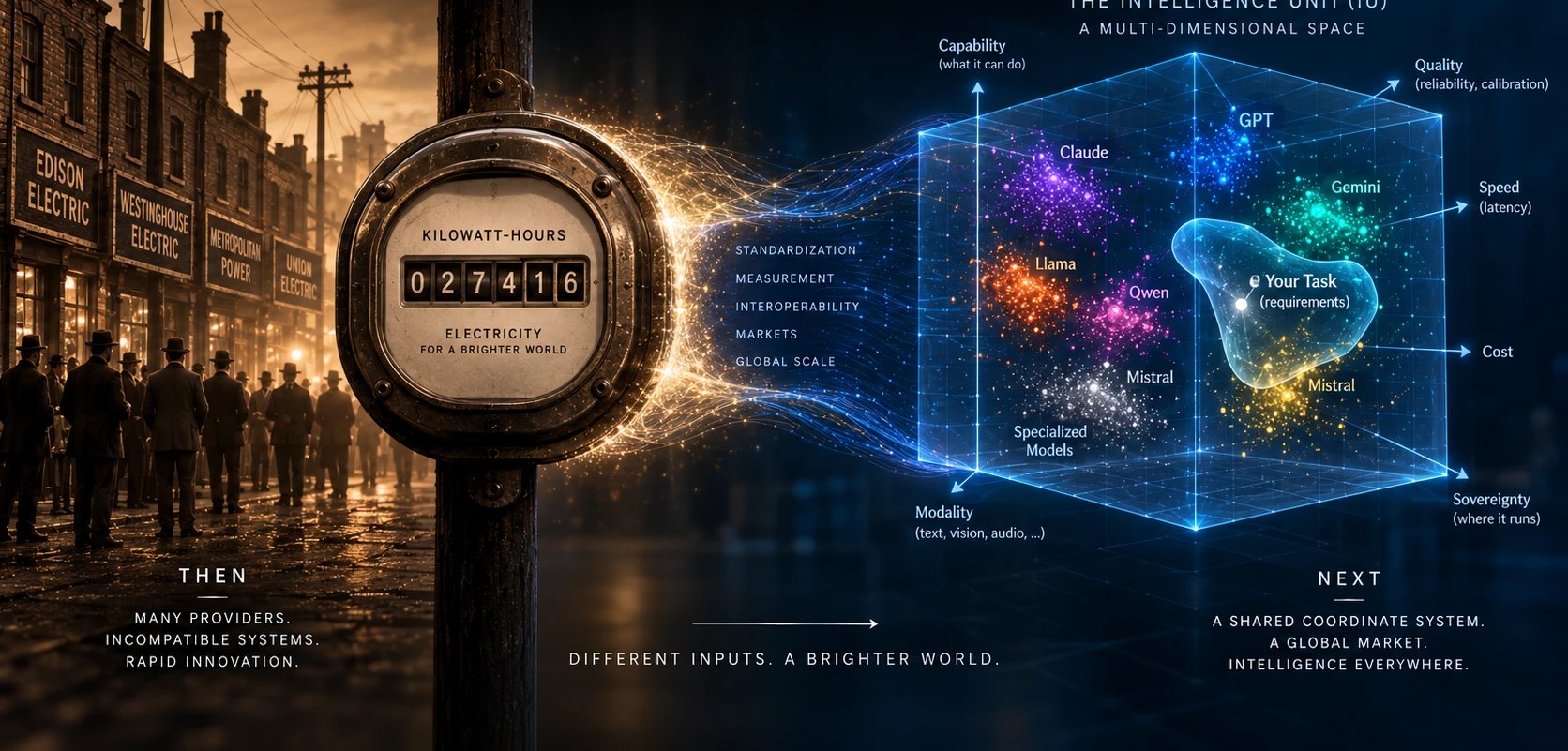
A brass kilowatt-hour meter on a gaslit 1890s street, its glow streaming into a glowing multidimensional cube labelled with model names.
← Reveries · Eran Shir · EssayOctober 2026
The intelligence unit

We are buying intelligence by the kilogram of coal.

Tokens measure the fuel, not the light. AI in 2026 looks like electricity in 1890, and the fix is not a meter.

The short version

Here is the whole argument in seven lines, for the people who scroll.

  1. In 1890 you bought a power company. By 1920 you bought kilowatt-hours, and the generator disappeared behind the meter.
  2. In 2026 we buy named models and pay by the token. Tokens measure the fuel, not the light.
  3. A human picking a model from a dropdown is a person choosing a power company for each lamp. Model selection is a dispatch problem, and dispatch is a job for the grid.
  4. A kilowatt-hour is classical work, one number that adds up. Intelligence is quantum: models are states, tasks are observables, runs are measurements, and uncertainty is part of the product.
  5. The unit is the bit. Intelligence work is verified uncertainty removed, weighed against one frozen reference model, the candle. Knowledge work is compression, and compression already has a unit.
  6. Verification is the bottleneck, and cheap typed judges turn it into a market of its own.
  7. My bet: the winner will not own the smartest model. It will own the map, and it will light the candle.

The long version starts in 1890.

01Then

Standardization, not a better dynamo, made electricity a market.

How electricity stopped being a brand

In 1890 there was no electric bill. You subscribed to a system.

Edison sold direct current and Westinghouse sold alternating current, and a city could have a dozen private power companies, each with its own voltage, its own frequency, and its own wires strung down the street. Your lamp worked on one company's current and died on another's. Switching suppliers meant rewiring the building.

Then, over about thirty years, the whole thing untangled itself. Standards arrived. Alternating current made long-distance transmission practical, so generation could move out of the city and get big. The networks merged, the regulators showed up, and somewhere in the middle of all that a meter appeared on the wall that counted consumption in one unit, the kilowatt-hour.

The breakthrough was the abstraction. The hardware came second.

Coal, hydro, gas, and later nuclear and solar: the customer stopped caring which one made the power. You pay for the useful product, and the machinery behind it becomes somebody else's problem.

That abstraction is what made a market possible, and I would argue it is what made the 20th century possible. The century of the electron ran on a billing unit.
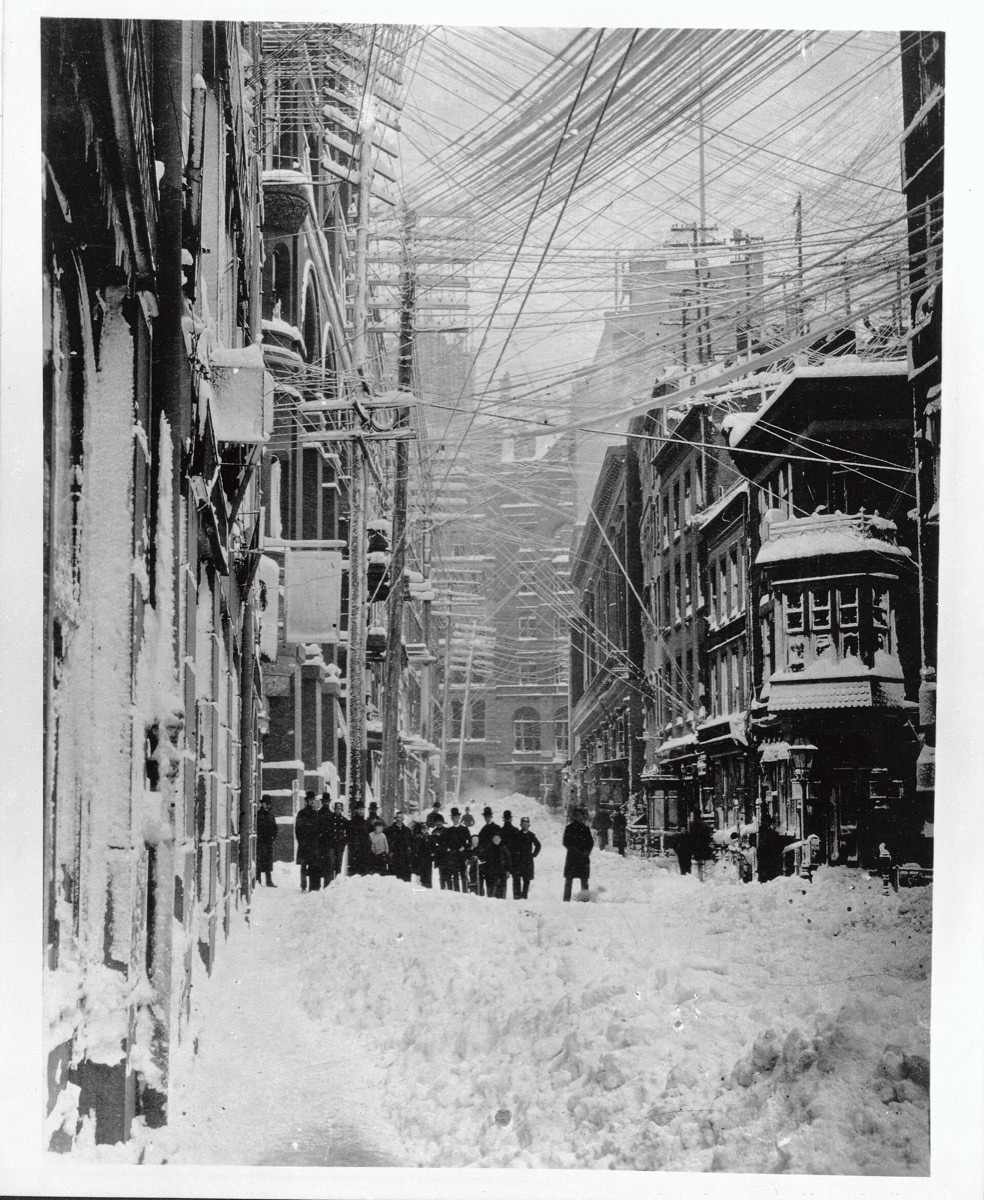
New York street in March 1888 under the Great Blizzard, with dozens of sagging telegraph and electric wires on tall poles.
New York, March 1888. Every company strung its own wires. The blizzard brought most of them down, and the city ordered them underground.Public domain
Dossier

Fifteen years that turned a gadget into a grid

Scroll sideways · click a card
02Now

Nobody wants a model. They want the task done.

AI in 2026 is electricity in 1890

We buy named models. GPT, Claude, Gemini, DeepSeek, Qwen. Each comes with its own harness, which is the software wrapped around the model that turns it into a worker, and its own tokenizer, which is how it chops text into the pieces it charges you for. Cost and latency differ by a factor of a hundred between them. Some run in the cloud and some on your laptop, some are open and some are not.

But nobody actually wants a model. People want their bug fixed and their invoice reconciled. They want the scene interpreted and the support case closed.

Once more than one supplier can do the job, only one question matters economically:

What is the cheapest intelligence that completes this task to the capability, quality, latency, privacy, and reliability I require?

Once you ask that question seriously, the model starts to disappear behind the market, the same way the generator disappeared behind the meter.

03Absurd

Dropdowns are the 1890 way of buying power.

Humans picking models is absurd

If you stop and look at what we actually do today, it is a little embarrassing.

There is a dropdown. A human reads a leaderboard, picks a name, and uses it for everything until the next launch day, when they read the leaderboard again.

That is a person in 1890 choosing a power company for each lamp in the house.

Now if we run the numbers, we will discover that one agent doing real work makes thousands of cognitive calls a day. Parse this, plan that, check the schema, write the test, summarize the thread, decide whether to escalate. Each call has different requirements. A few need a frontier model, most need something small and fast, and some are not allowed to leave the building at all.

Nobody is going to route those by hand, and nobody is going to write the routing rules by hand either, because the models, the prices, and the tasks all change weekly.

"Which model should I use?" is not a hard question. It is the wrong question, asked at the wrong layer by the wrong party.

Model selection is a dispatch problem, and dispatch is a job for the grid.

04Unit

Tokens bill the fuel, never the light.

Tokens are the wrong unit

Tokens are a good unit for the provider, because they track how much inference work the provider did.

They are a bad unit for the buyer, because they track none of the things the buyer cares about. A token says nothing about difficulty, correctness, depth of reasoning, whether the task got done, or what it was worth. One model may solve a problem in 3,000 tokens while another burns 30,000 and gets it wrong, and the second one sends the bigger invoice.

Billing by token is billing the electricity customer by the kilograms of coal burned at the plant. It measures production and says nothing about the product.

A mature market needs a unit that does not depend on who made the intelligence.

05Quantum

Intelligence is known only through probabilistic measurement.

Electricity is classical. Intelligence is quantum.

This is where the analogy gets interesting, because this is where it starts to break.

A kilowatt-hour is classical work. It is one number, it adds up, and measuring it changes nothing. The generator doesn't matter and the customer doesn't care.

Intelligence doesn't behave like that.

One model is brilliant at code and mediocre at spatial reasoning. Another is great at math but slow. A third is slightly weaker and a hundred times cheaper, and a fourth runs on your laptop and wins every time privacy or sovereignty matters, where sovereignty means who legally controls the data and the machine it runs on.

No single number captures that, and any leaderboard that gives you one is lying to you.

And it gets worse, because you never know where a model stands until you test it, and the same task passes today and fails tomorrow. Every test teaches you something and leaves something unknown.

Physics has a framework for exactly this situation, systems you can only know through probabilistic measurements, and it is called quantum mechanics. I am not claiming cognition is quantum. I am claiming the bookkeeping is the same, and the bookkeeping has four pieces.

Models are states
A model is a vector in a space of abilities: coding, math, visual reasoning, planning, research, tool use, long-horizon autonomy, domain expertise. You never see the vector itself. You see a distribution over it, and that distribution is the model's error bars.
Tasks are observables
A task asks the state one question, pass or fail, and gets back an answer with a probability attached.
Runs are measurements
Every verified run collapses a little of the uncertainty and updates the state. The map is a ledger of measurements.
Uncertainty is part of the product
Two models with the same average and different error bars are different products, and buyers pay for the confidence.

If you want the math, and the places where the frame creaks, I wrote it up separately: deep dive.

Delivery conditions are not part of the state. Latency, price, energy, privacy, sovereignty, context size, hardware: these are boundary conditions. They decide who is allowed to bid on a task, and they are not abilities.

So there is no best model. There are Pareto frontiers, which is the economist's name for the set of options where you cannot do better on one axis without paying on another.

06Map

Every trace sharpens the map; the map is never finished.

The map learns itself

So who assigns the coordinates? Nobody does, and that is the point. The market assigns them, continuously.

Every execution produces a trace: the task, its estimated difficulty, the model and version, the context and tools, the latency and cost, where it ran, what it produced, how it was verified, whether it passed, and what happened downstream.

Each trace is one more observation of where that model lives in ability space. After a thousand traces the picture is fuzzy. After millions it is sharp, and after billions of diverse real-world traces it is extraordinarily precise.

The uncertainty stays explicit the whole way. Where there is little evidence the region is wide, and as evidence accumulates the bounds contract. Models change, prices move, infrastructure shifts, and the map never freezes.

This is not a benchmark published twice a year. It is a continuously updated map of machine intelligence.

The axes themselves are learnable too. We will start with human labels, coding, math, vision, planning, and with enough traces the real groupings emerge on their own. "Reasoning" may split into several independent abilities. Tasks we think are unrelated may rise and fall together across every model, and abilities nobody has named may predict real-world success better than any benchmark category does.

An exchange big enough becomes an observatory of machine cognition.

07Work

A bit of verified uncertainty removed, weighed against a candle.

The unit is work

A kilowatt-hour is not a unit of electricity. It is a unit of work: energy delivered, whatever made it. Classical work.

Intelligence work is the quantum version, and it is work against uncertainty. Before the run, the task might fail. After a verified pass, it can't. The work done is the uncertainty removed, and the unit of uncertainty already has a name. It is the bit.

Shannon defined the bit in 1948 as the amount of information that halves your uncertainty, and knowledge work is exactly that. You start with a space of possible answers and you collapse it to the right one. A verified pass on a task the candle gets right once in a thousand tries is worth ten bits, which is the number of yes-or-no questions the candle would have needed answered to get there. Intelligence work is compression, and compression has had a unit for seventy-eight years.

And no, this does not threaten the second law of thermodynamics. The agent brings order to the task and dumps entropy as heat in a datacenter, and the kilowatt-hours pay for the bits. A human brain does its knowledge work on about twenty watts. The machines that generate intelligence today draw kilowatts per rack and turn nearly all of it into heat, which makes them, per bit of verified work, some of the most wasteful entropy producers we have ever built. The second law is safe. The electricity bill is the proof.

So let's freeze one reference model, open weights, public, never updated. Astronomers would call it a standard candle, a source whose brightness you know, so that you can measure everything else against it. I'll just call it the candle.

If we weigh every task by how often the candle passes it, then a task the candle passes half the time is worth one bit, a task it passes once in a thousand runs is worth ten, and a task it always passes is worth nothing. That last one is correct, because there was no uncertainty and so there was no work.

Intelligence work is bits of verified uncertainty removed. Add them up. That's the kilowatt-hour.

It is additive and it does not depend on which model did the work. It is defined by the outcome and not by the effort, and it is measured by the exchange rather than claimed by the supplier.

The candle will fall behind, and that is fine. Physics kept the kilogram as a platinum cylinder in a vault near Paris for 130 years, and then redefined it through a constant of nature once the instruments were good enough. The unit outlives the artifact. The deep dive has the protocol.

08Match

Find the cheapest supplier that clears the confidence bar.

Tasks live in the same space

Models are supply and tasks are demand, and they share one set of coordinates.

A task says: coding high, planning medium, tool use high, verified reliability above 99 percent, latency under 120 seconds, data stays in the EU, isolated execution, and a maximum price.

That is a requirement region, and routing becomes a matching problem: find the cheapest available intelligence whose distribution satisfies the requirement region with enough confidence.

The exchange decides how to fulfill it. A small model, a specialist, three models in parallel, a frontier model after an escalation, or a box in your own datacenter. The customer bought the outcome and never met the generator.

Power grids dispatch by merit order, which means one ordering of generators from cheapest to most expensive, filled from the bottom up. Intelligence has no single ordering. Small local models dominate routine cognition, mid-tier models dominate the middle, specialists own their corners, and frontier models win only where the extra capability pays for the extra cost.

An agent doing thousands of cognitive operations a day will drink from dozens of suppliers, and its user won't know, won't care, and won't be asked. That is the point.

The question stops being "which model is best?" and becomes "which model is on the frontier for this task?"

09Build

The loop runs today; the standard falls out of it.

This is buildable today

Nobody needs to wait for the next generation of models.

The loop already works today: you characterize the task, build its requirement profile, route it, execute, verify, record the trace, update the model's position, escalate if the verification failed, and account for all of it.

Early versions don't need a perfect standard. They price jobs and gather evidence, and the standard emerges from billions of executions.

What accumulates is a dataset that maps every task to its requirements, to the model that ran it, and to the quality, latency, cost, and verification result that came back. That is a live map of the global intelligence supply surface, and it is the asset.

10Verify

Whatever is cheap to verify becomes liquid first.

The hard part is verification

If verifying an answer is much cheaper than producing it, intelligence commoditizes fast.

Code compiles and tests. Math checks. Data analysis reproduces, research claims check against sources, schedules check against constraints, financial operations reconcile, and autonomous policies run in simulation. Those regions of ability space become liquid first.

Open-ended strategy, scientific taste, management judgment, and creative work are harder, because evaluating the answer costs nearly as much as producing it. Those stay illiquid longer. Not forever, but longer, and different regions get liquid at different speeds.

The verifier doesn't have to be a frontier model either. A new class of judge models answers a bounded question, true or false, pick one, score it, in a fraction of a second for a fraction of a cent, and returns a probability instead of prose. TypeSafe's Jev started it in September. OpenAI answered with the Decisions API, and open weights followed within weeks with Laya, Kev, and djev. They are weak at math and code, and they give up some accuracy to a reasoning judge. That is fine, because you can accept when the judge is confident and escalate the tail to a bigger one.

Verification has a Pareto frontier too, and the same market routes it.

The other frictions, briefly:

  • - Figuring out what a task needs is itself an intelligence problem.
  • - Observations are sparse in specialized domains. A model can have millions of coding traces and almost none in protein chemistry, and the map has to be honest about that.
  • - Agent state is sticky. Context, memory, cached prompts, credentials, and environments all pile up inside one supplier, and portable state is what makes the market liquid.
  • - Sequential escalation is slow and parallel execution is expensive. Prediction, speculation, and cancellation are how you buy down that tradeoff.
  • - The moment the unit moves revenue, suppliers will optimize against it. Real traces, hidden evaluations, and downstream outcomes survive that. Static public leaderboards don't.
11Breaks

No last mile, copyable weights, and intelligence that breeds intelligence.

Where the analogy breaks, and why it matters

I count three places where it breaks, and they all matter, each in its own way.

Wires were a natural monopoly, because running a second set of cables to every building is stupid. Intelligence has no last mile. Many suppliers reach the same customer over the same network, so distribution won't consolidate the way power did.

Weights copy. Production of intelligence can be radically more distributed than production of power ever was.

And the big one: intelligence improves the production of intelligence. Chips, compilers, data, training, datacenter optimization. More intelligence makes cheaper intelligence, which makes more intelligence, and electricity never had a recursive loop like that.

Then add demand that is wildly elastic. As cognition gets cheap, agents do work that no human was ever paid to do, so the price of a fixed capability collapses while total spend on intelligence rises. Jevons saw the same thing in 1865, when better steam engines made Britain burn more coal rather than less. This is Jevons for cognition.

12Wins

The winner owns the map, not the smartest model.

Who wins

The mature market has generators that train and serve models, exchanges that match tasks with suppliers, routers, verifiers, retail packagers, and agents consuming all of it.

My bet: the strategically powerful company won't own the smartest model.

It will own demand aggregation and the infrastructure that decides which intelligence gets purchased.

The asset isn't routing volume. It is the continuously learned map of machine intelligence: which models solve which problems, which abilities predict success, when cheap is enough, when to escalate, how much verification a task really needs, and how the price-performance frontier moves week to week.

What you end up with is one entity that is, at the same time, a benchmark lab, a commodity exchange, a grid dispatcher, a market maker, and an observatory of cognition.

13Standard

Ten properties of a unit nobody owns.

What an open IU standard should be

If I had to write the standard down, it would have ten properties:

  1. 1. Provider-independent. Not tied to a model, tokenizer, or architecture.
  2. 2. Multidimensional. Preserves the differences instead of collapsing them into a score.
  3. 3. Outcome-oriented. Grounded in useful cognitive results, not raw compute.
  4. 4. Probabilistic. Represents uncertainty about what a model can do.
  5. 5. Continuously calibrated. Updated from real-world traces, against a frozen reference.
  6. 6. Verifiable. Uses objective outcomes wherever they exist.
  7. 7. Extensible. Absorbs new modalities and newly discovered abilities.
  8. 8. Market-usable. Supports pricing, service-level agreements, routing, and settlement.
  9. 9. Sovereignty-aware. Knows where and under whose control intelligence was produced.
  10. 10. Hard to game. Broad traces and hidden evaluations, not a static leaderboard.

We don't need to agree on what intelligence is. Philosophers can keep that one. We need to agree on how to map useful machine cognition.

14 · The grid

Models become generators.

Agents become appliances.

Routers and exchanges become the grid.

Every trace makes the map better.

Electricity needed a meter.

Intelligence needs a map and a standard candle.

And whoever lights that candle, a company, a consortium, or an open standard, may end up defining the market.